Platform-agnostic abstraction layer for input event handling.
More...
Platform-agnostic abstraction layer for input event handling.
One essential building block of the ImFusionGUI component is the generic abstraction layer to handle input events from the user such as mouse, touch, or keyboard events.
The main classes and interfaces of this component are as follows:
- The InputEvent class for representing user inputs in a GUI.
- Classes receiving and handling InputEvents, usually referred to as "[Input] Event Handlers". There is no single base interface for them, however they usually implement a function with the signature EventResult handleInputEvent(const InputEvent& event). Most classes of this component such as Display, View, ViewObject, or ViewOverlay have such a member function.
- All event handlers return an EventResult to indicate how to continue and if the GUI should show any visual reaction to the event (such as mouse cursor, tooltip, context menu).
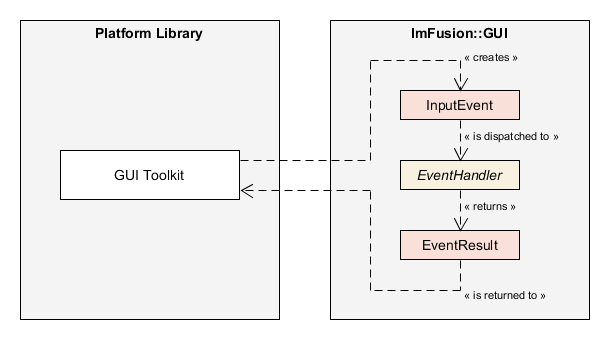
High-level overview of the ImFusion::GUI event handling flow.
A separate platform-specific wrapper will convert the native input events from the GUI toolkit (e.g. Qt) to the generic InputEvents. The InputEvent is then passed to one or multiple event handlers (usually the Display). They return a EventResult instance which can eventually converted back to platform-specific actions. The ImFusion SDK provides the necessary classes for integration into a Qt-based application. Integrations for other GUI toolkits are usually straight-forward to implement.
A basic input event handler function for a button overlay could look like this:
EventResult MyButtonOverlay::handleInputEvent(const InputEvent& event)
{
EventResult result;
if (const MouseEvent* mouseEvent = event.asMouseEvent())
{
if (m_viewport.includesPoint(mouseEvent->position().cast<int>()))
{
m_buttonOverlay->setHighlighted(true);
{
result.stopPropagation = true;
m_wasPressed = true;
}
if (!m_wasPressed && !m_tooltip.empty())
result.tooltip = m_tooltip;
{
m_wasPressed = false;
signalClicked.emitSignal();
if (showMenu())
result.contextMenu = createMenu();
result.stopPropagation = true;
}
}
else if (m_buttonOverlay->isHighlighted())
{
m_buttonOverlay->setHighlighted(false);
m_wasPressed = false;
}
}
return result;
}
@ Press
A mouse button was pressed.
Definition InputEvent.h:279
@ Release
A mouse button was released.
Definition InputEvent.h:280
Due to the hierarchical nature of the view framework a single InputEvent is often passed to multiple handlers in a cascading fashion until it is consumed in a terminal fashion and propagation stops. A typical usage looks like this
EventResult result;
for (ViewObject* object : objects) {
result.combine(object->handleInputEvent(event));
if (result.stopPropagation)
return result;
}
return result;
|
| enum class | ImFusion::GUI::MouseCursorShape {
ImFusion::GUI::MouseCursorShape::Default
, ImFusion::GUI::MouseCursorShape::PointingHand
, ImFusion::GUI::MouseCursorShape::Crosshair
, ImFusion::GUI::MouseCursorShape::Help
,
ImFusion::GUI::MouseCursorShape::Busy
, ImFusion::GUI::MouseCursorShape::Wait
, ImFusion::GUI::MouseCursorShape::OpenHand
, ImFusion::GUI::MouseCursorShape::ClosedHand
,
ImFusion::GUI::MouseCursorShape::SizeVertical
, ImFusion::GUI::MouseCursorShape::SizeHorizontal
, ImFusion::GUI::MouseCursorShape::SizeDiagonalBLTR
, ImFusion::GUI::MouseCursorShape::SizeDiagonalTLBR
,
ImFusion::GUI::MouseCursorShape::SizeAll
, ImFusion::GUI::MouseCursorShape::SplitVertical
, ImFusion::GUI::MouseCursorShape::SplitHorizontal
, ImFusion::GUI::MouseCursorShape::TextInput
,
ImFusion::GUI::MouseCursorShape::Forbidden
, ImFusion::GUI::MouseCursorShape::Blank
, ImFusion::GUI::MouseCursorShape::Custom = 100
} |
| | Enumeration of cursor shapes that are usually available on all platforms. More...
|
◆ MouseCursorShape
#include <ImFusion/GUI/MouseCursorShape.h>
Enumeration of cursor shapes that are usually available on all platforms.
| Enumerator |
|---|
| Default | Use the default cursor shape.
|
| PointingHand | A pointing hand cursor that is typically used for clickable elements such as hyperlinks.
|
| Crosshair | Crosshair cursor, typically used to help the user accurately select a point on the screen.
|
| Help | Indicate that help information is available, usually a pointer with a question mark.
|
| Busy | The program is busy in the background but the user can still interact with the interface.
|
| Wait | The program is busy and the user can't interact with the interface.
|
| OpenHand | Indicate that something can be grabbed and moved around.
|
| ClosedHand | Indicate that something is currently being grabbed and moved around.
|
| SizeVertical | Indicate that you can resize or move something vertically.
|
| SizeHorizontal | Indicate that you can resize or move something horizontally.
|
| SizeDiagonalBLTR | Indicate that you can resize or move something diagonally either in the bottom left or top right corner.
|
| SizeDiagonalTLBR | Indicate that you can resize or move something diagonally either in the top left or bottom right corner.
|
| SizeAll | Indicate that you can resize or move something in all directions.
|
| SplitVertical | The handle/item/row can be resized vertically, for instance to adjust the amount of available space.
|
| SplitHorizontal | The handle/item/column can be resized horizontally, for instance to adjust the amount of available space.
|
| TextInput | Indicate that you can enter text underneath, usually represented by an I-beam.
|
| Forbidden | Usually a slashed circle indicating that the action is impossible/not allowed.
|
| Blank | Don't render any cursor.
|
| Custom | If you need to extend this enumeration with application-specific shapes, this is the first value you can use.
|
