 |
ImFusion C++ SDK 4.5.0
|
|
ImFusion C++ SDK 4.5.0
|
Low-level data structures for handling DICOM data. More...
Low-level data structures for handling DICOM data.
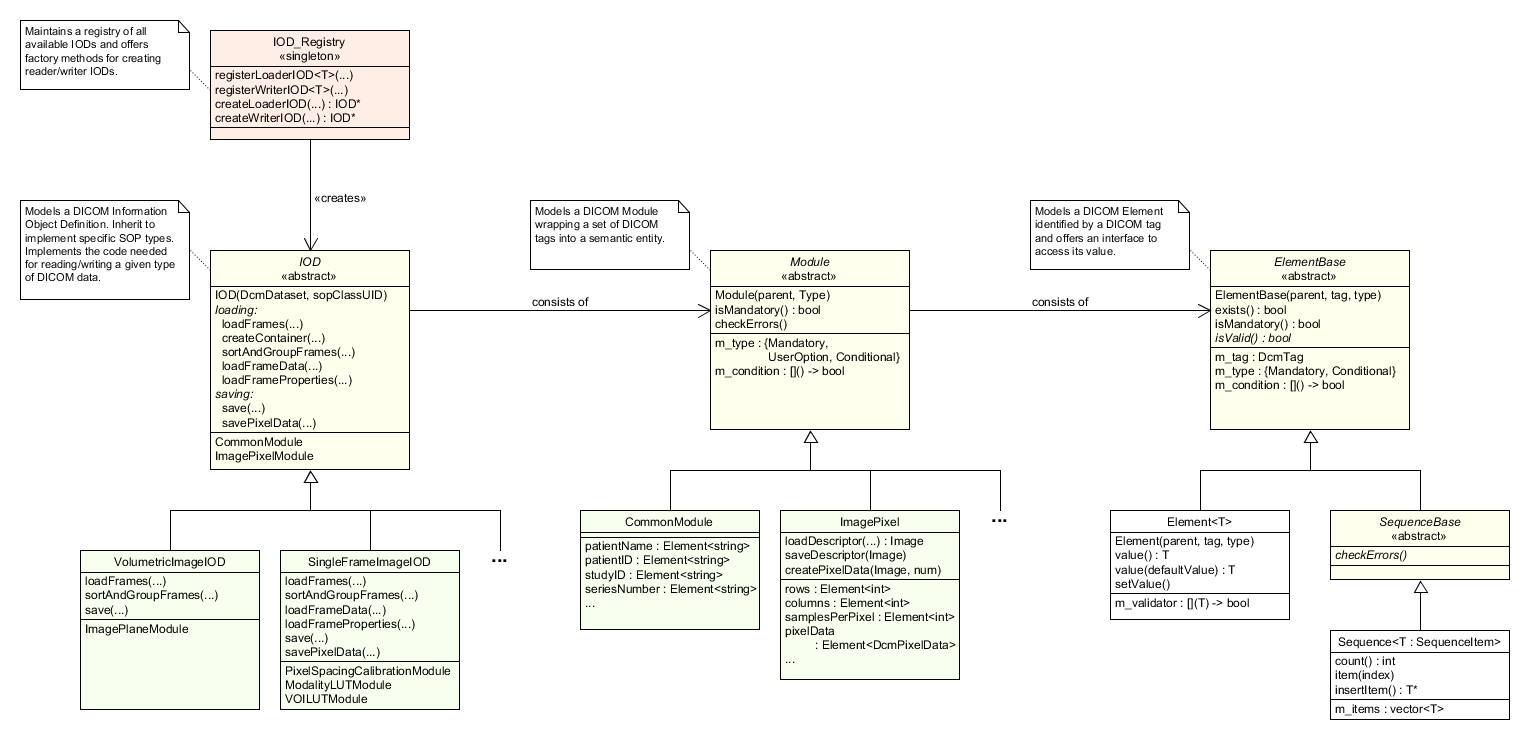
The core level of the ImFusion DICOM API revolves around a couple of central classes modeling the structure of DICOM data. As illustrated in the following class diagram, there are three essential abstract base classes/interfaces.
The set of IODs that are available for loading/saving DICOM data is managed by the IOD_Registry. This enables API developers and third-party plugins to extend the ImFusion Dicom Plugin with support for additional DICOM SOPs and other custom types.
The core API of the ImFusion DICOM plugin provides a fine-grained error handling interface to track errors while handling DICOM files. The central class for this is the ErrorRecorder interface. Inherit from this class if you need to handle error occurring during loading/saving DICOM data. The majority of the classes in the Dicom plugin (e.g. Dicom::Module, Dicom::IOD, DicomLoader) implement this interface and automatically propagate errors up the different hierarchy levels.
A Dicom::Error distinguishes three severities:
In case of warnings or non-critical errors, the user has to decide how to proceed with the loaded data.
Since DICOM is a very extensive standard, the ImFusionLib might not load/store all the (meta)data that are required for a specific application. The best way to support these cases, is to extend the DicomLoader and/or DicomWriter. There are currently two options for this:
Implementing a Dicom::Extension is the best way if you need to load/store additional metadata, like a custom DataComponent or change certain parameters of the image data. See Extensions for more information.
In some cases, creating a Dicom::Extension is not enough. For example due to an unsupported SOP class which produces a wrong SharedImageSet. In those cases it might be necessary to derive a custom Dicom::IOD. Check the documentation of Dicom::IOD for details on the individual interfaces that need to be implemented.
Also check if it makes sense to derive from Dicom::MultiFrameImageIOD or Dicom::EnhancedMultiFrameImageIOD instead of writing a Dicom::IOD from scratch.
Namespaces | |
| namespace | ImFusion::Dicom |
| Low-level and intermediate-level interfaces for working with DICOM data. | |
| namespace | ImFusion::Dicom::VolumeReconstruction |
| Namespace containing helper functions to reconstruct potential volumes from a set of individual DICOM frames. | |
Classes | |
| class | ImFusion::Dicom::ElementList |
| Interface for classes that consist of Elements. More... | |
| class | ImFusion::Dicom::value_error |
| Exception specialization for DICOM element retrieval. More... | |
| class | ImFusion::Dicom::Element< T > |
| Dicom Element with a concrete value type. More... | |
| struct | ImFusion::Dicom::Error |
| Structure for storing errors occurring during loading/saving DICOM data. More... | |
| class | ImFusion::Dicom::ErrorRecorder |
| Error handling interface for the Dicom module. More... | |
| struct | ImFusion::Dicom::FrameDescriptor |
| Descriptor for a single DICOM frame that is used during the loading process as intermediate representation before eventually converting the image data to a SharedImageSet. More... | |
| class | ImFusion::Dicom::IOD |
| Base class of a Dicom Information Object Definition (IOD). More... | |
| class | ImFusion::Dicom::IOD_Registry |
| A registry that assigns a IOD implementation to a SOP class UID. More... | |
| class | ImFusion::Dicom::ModuleList |
| Interface for classes that consist of modules. More... | |
| class | ImFusion::Dicom::Module |
| Base class for Dicom Modules. More... | |
| class | ImFusion::Dicom::SequenceItem |
| Base class for sequence items. More... | |
| class | ImFusion::Dicom::Sequence< T > |
| Concrete sequence of items of type T, which must be derived from SequenceItem. More... | |
| class | ImFusion::PhilipsQLabIOD |
| Loads ultrasound volume stored by Philips QLab software. More... | |